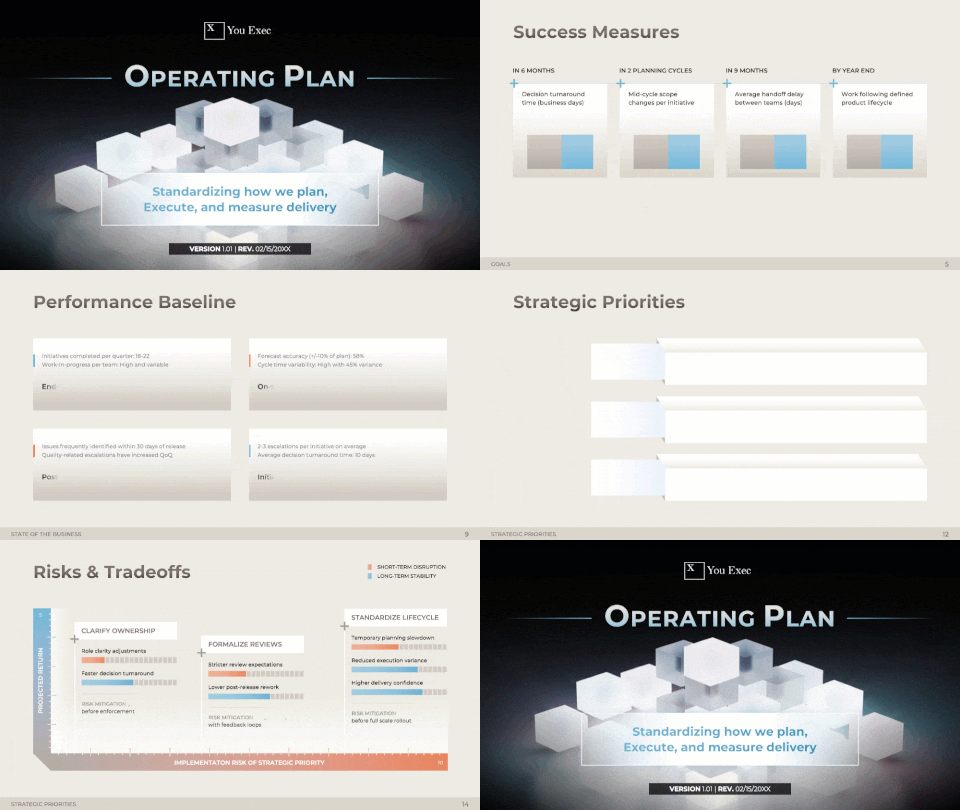








Need a way to propose ideas or plans that survive scrutiny and withstand debate? In meeting environments, conclusions often surface before context and unorganized discussions overshadow disciplined thinking. We adapted Amazon’s Six-Pager Memo into a structured presentation-friendly format that enforces narrative clarity and amplifies persuasive impact. Sequenced across the Six-Pager’s sections of Introduction, Goals, Tenets, State of the Business, Lessons Learned, and Strategic Priorities, the slides strengthen analytical rigor, align metrics with intent, and separate evidence from opinion.
Over time, this approach reshapes how teams make decisions and betters institutional judgment. Debates become grounded in shared facts rather than hierarchy, cross-functional alignment improves because assumptions are surfaced early, and execution confidence rises as priorities are tied to measurable outcomes.
Section 1: “Introduction”
The opening section establishes the narrative contract and clarifies why the discussion exists and why the moment matters. In practice, this forces teams to articulate the problem before rushing to the solution. Instead of beginning with a recommendation, the presenter defines the current environment, the trigger events, and the implications of inaction.

Section 2: “Goals”
The Goals section converts intent into commitment. Goal Definition articulates the outcomes that must change, while Success Criteria establishes how progress will be detected. The emphasis is not on aspiration but on measurement. The presenter declares what success means in operational terms and what metrics will confirm it.

Clear goals influence resource allocation and tradeoff discipline. When objectives are explicit, teams can prioritize with confidence and avoid diffused effort. Well-constructed goals also elevate the quality of debate. Instead of arguing over activities, stakeholders evaluate whether actions move the needle on defined metrics. That shift encourages data-backed reasoning and reduces reliance on hierarchy or opinion.

Download presentation
It's yours now · grab it in any other format, free.
Section 3: “Tenets”
Tenets provide the guardrails that shape how decisions are made. Guiding Principles aren’t just descriptions of culture; they define operational expectations. Guardrails reduce ambiguity without imposing rigidity. When these principles are explicit, teams can test proposals against them and surface contradictions early. And in fast-moving sectors where coordination costs rise with scale, consistent rules prevent fragmentation. That consistency strengthens institutional memory and reduces the risk of ad hoc decision patterns that erode trust.

Section 4: “State of the Business”
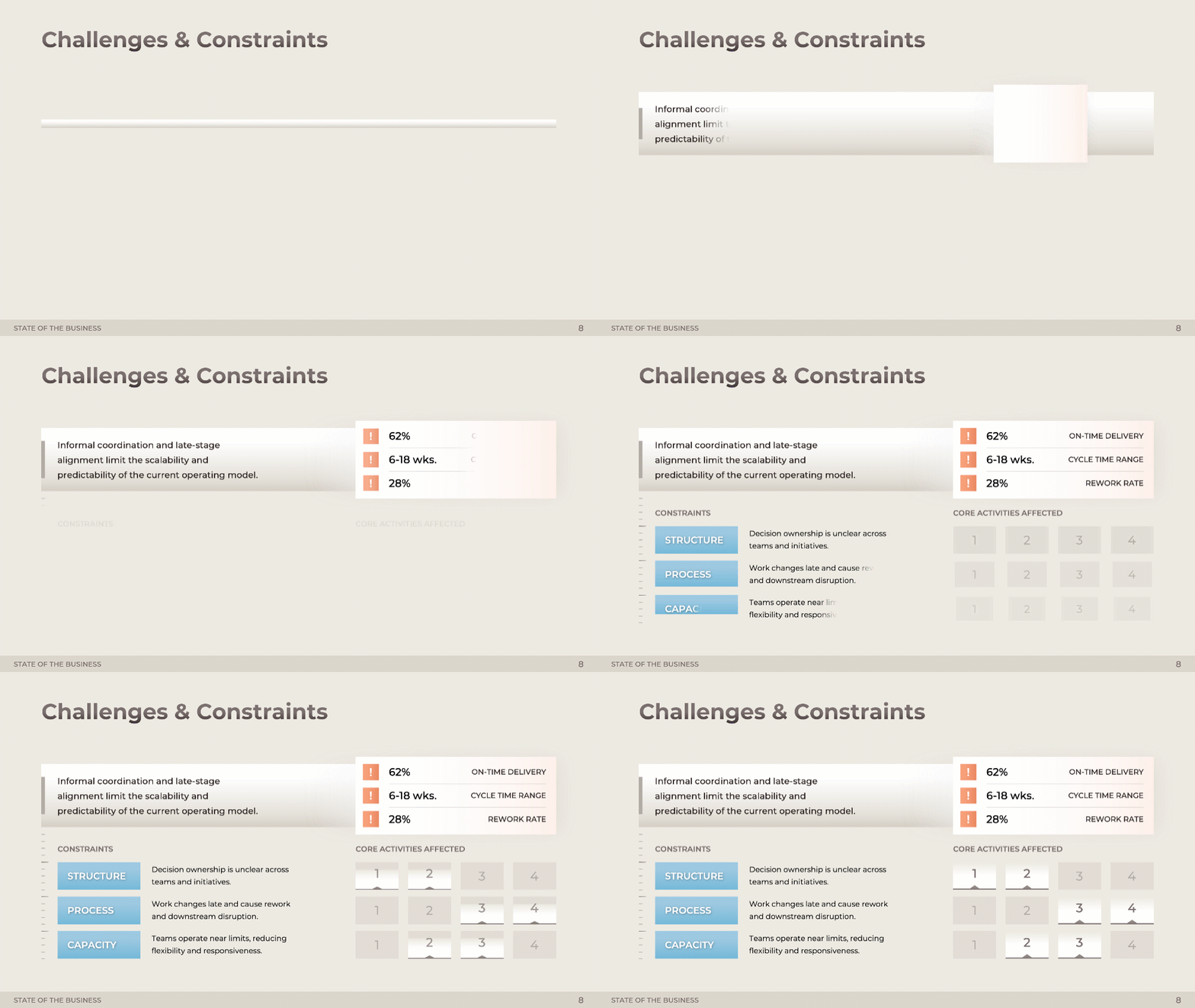
Any strategy without a baseline lacks credibility. The State of the Business section forms a diagnostic foundation. Its elements describe how work flows today, where friction occurs, and what the data reveals about outcomes. Transparency here builds trust in the recommendations that follow.
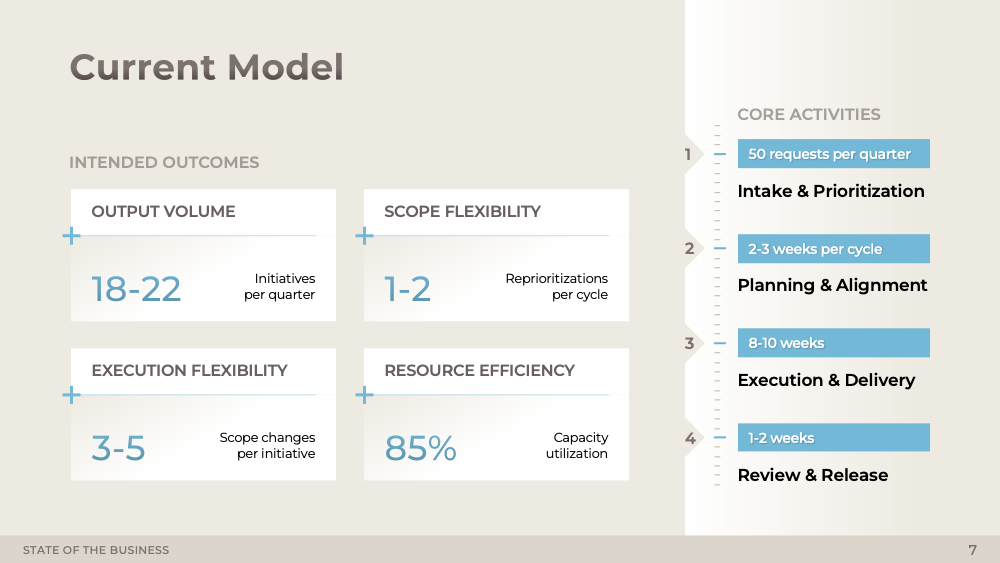

Quantified baselines prevent selective storytelling and metrics establish facts that cannot be debated away. This objectivity supports rigorous prioritization and discourages defensive narratives. In an era of tighter margins and higher scrutiny from boards and investors, such candor signals maturity. By surfacing constraints explicitly, leadership can differentiate structural issues from isolated failures. This perspective avoids blame and instead focuses on system design. When teams see that the challenge lies in the model rather than individuals, alignment improves and resistance declines.
Section 5: “Lessons Learned”
Reflection without interpretation has limited value. Insights from Prior Period distill what worked and what did not, grounded in data rather than sentiment. This step legitimizes progress while confronting setbacks. Balanced assessment strengthens credibility and sets a tone of accountability.

Implication for the Future translates hindsight into forward action. Start, Stop, and Continue statements convert abstract insight into behavioral commitments. The section does not dramatize failure or overstate success. It identifies patterns and declares adjustments.
Download presentation
It's yours now · grab it in any other format, free.
Section 6: “Strategic Priorities”
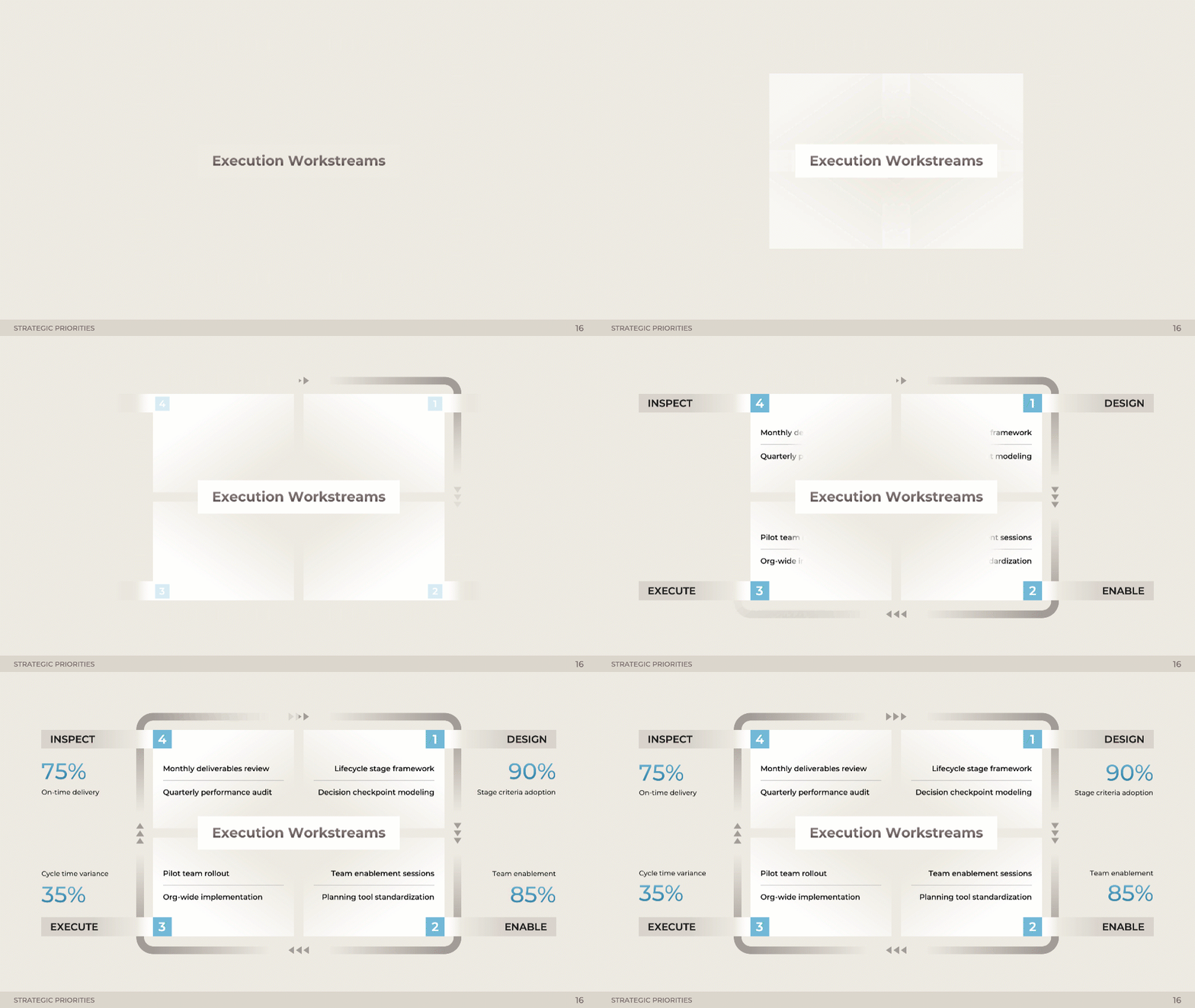
The final section moves from analysis to commitment. Strategic Priorities articulate the few initiatives that will materially shift performance. Each priority defines an outcome, specifies how it will be achieved, and quantifies the expected improvement. That structure prevents vague transformation language and demands operational precision.

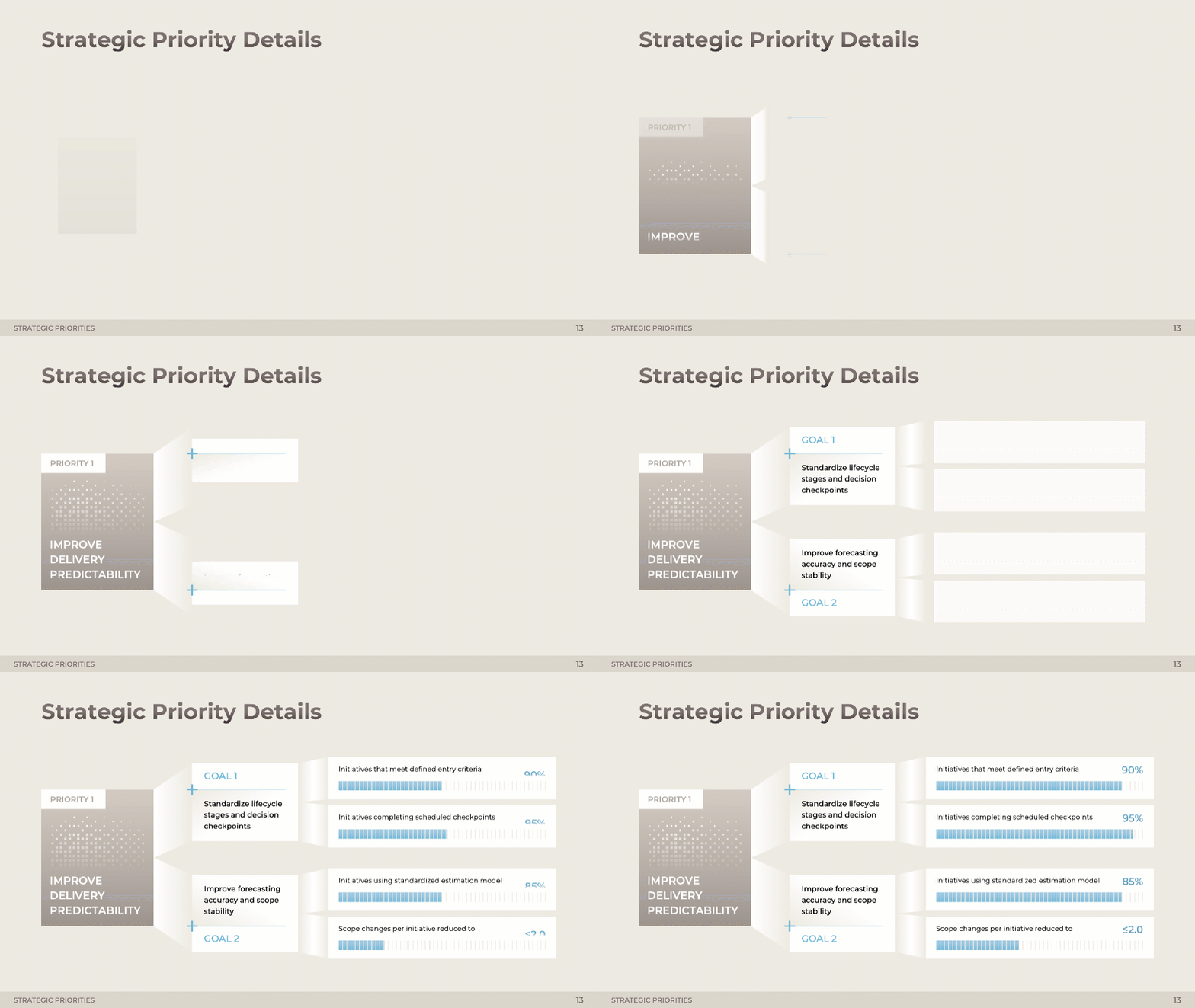
Priority Details translate ambition into executable workstreams. Rationale clarifies why the initiative matters, primary goals specify structural changes, and execution activities identify concrete steps. This cascade from outcome to action ensures coherence and accountability.

Execution Blueprint, Risks and Tradeoffs, and Near-Term Roadmap complete the narrative. The blueprint clarifies ownership and sequencing. The risk map acknowledges disruption and sets mitigation approaches. The roadmap converts aspiration into staged commitments that move from uncertainty toward stability. Together, these tools demonstrate that the plan is deliberate, measurable, and resilient under scrutiny.

Conclusion
When ideas move through a structured progression from context to goals, from tenets to evidence, and from lessons to priorities, they earn the right to be debated seriously. The Amazon Memo raised the standard of how proposals are built and evaluated. It replaced slide theater with structured reasoning and makes tradeoffs explicit before commitments are made. For leaders who value clarity, accountability, and measurable impact, this approach strengthens both the quality of decisions and the confidence behind them.
Download presentation
It's yours now · grab it in any other format, free.